
Abstract
In the first quarter of 2026, the escalation of the U.S.-Iran conflict plunged the Strait of Hormuz—into a blockade crisis. As a core importer of Persian Gulf crude, Japan is facing its most severe supply shock since the 1970s oil crisis. Against this backdrop, Japan’s energy import structure has undergone an unprecedented reconfiguration. Within just one month, the country rapidly pivoted toward trans-Pacific supply chains, reflecting a forced and disorderly shift away from Middle Eastern dependence.
The Eye of the Storm
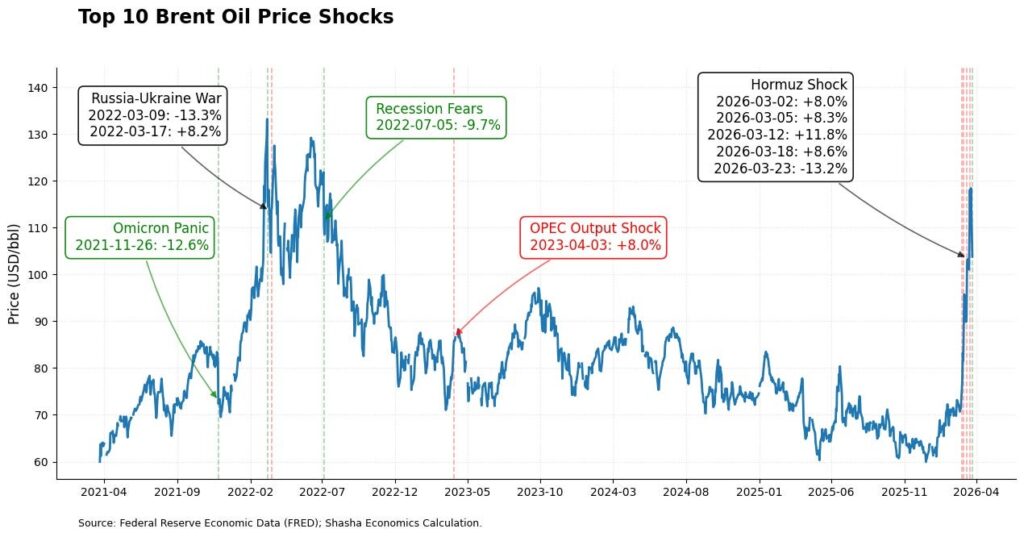
March 2026 has emerged as one of the most volatile periods in global energy market history. As shown in Figure 1, five of the top ten largest daily price moves in Brent crude occurred within this single month. The +11.8% surge on March 12 and the -13.2% plunge on March 23 unfolded within a narrow time window, forming a “price cardiogram” shaped by potential blockade risks in the Strait of Hormuz and diplomatic expectations. Under conditions of tightening liquidity and elevated uncertainty, the oil price has temporarily detached from supply-demand fundamentals, becoming an immediate reflection of geopolitical risk.
Thanks for reading! Subscribe for free to receive new posts and support my work.
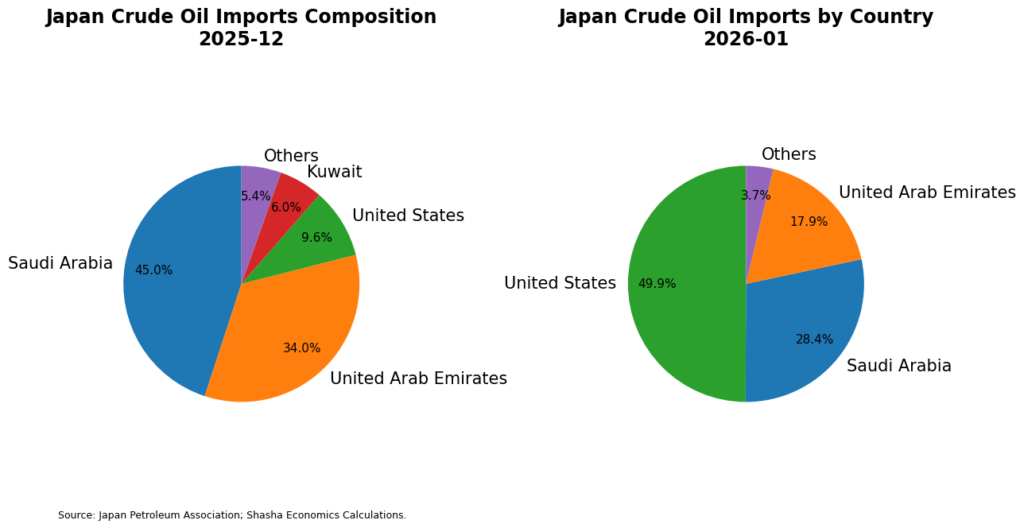
Before the crisis, the top three Middle Eastern suppliers—Saudi Arabia, the UAE, and Kuwait accounted for approximately 85% of Japan’s total crude imports (Figure 2). These nations are located in the sensitive zone of the U.S.-Iran conflict, and their maritime lifelines are acutely dependent on the Strait of Hormuz.
Kuwait, entirely located within the Persian Gulf, relies exclusively on the Strait of Hormuz for maritime exports, leaving it with no viable alternative routes under any blockade scenario. The UAE, despite having partial bypass capacity through ports such as Fujairah, still depends heavily on Hormuz for the majority of its commercial flows, leading to a rapid contraction in exports to Japan when risks escalate. Saudi Arabia, while possessing limited mitigation via Red Sea export routes, remains structurally dependent on Gulf-based production, limiting its ability to fully offset disruptions under extreme conditions.
A Rapid Strategic Pivot
Faced with the risk of supply disruption, Japan’s response was both immediate and large-scale. Import data records a historic turning point (Figure 2): between December 2025 and January 2026, the share of U.S. crude in Japan’s import mix surged from 9.6% to 49.9%. This nearly vertical expansion made the United States Japan’s largest single supplier. Simultaneously, the share from Saudi Arabia shrank from 45% to 28.4%, while the UAE dropped from 34% to 17.9%. This sharp reallocation underscores a strategic shift prioritizing supply security over cost considerations, as Japanese policymakers and firms scrambled to secure alternative sources.
This strategic shift reflects the choice of the Japanese government and enterprises to seek alternative sources at any cost to avoid a total energy cutoff. This “de-Middle Easternization” does not represent structural optimization but rather an emergency reconfiguration under extreme risk constraints.
The Cost of Diversification
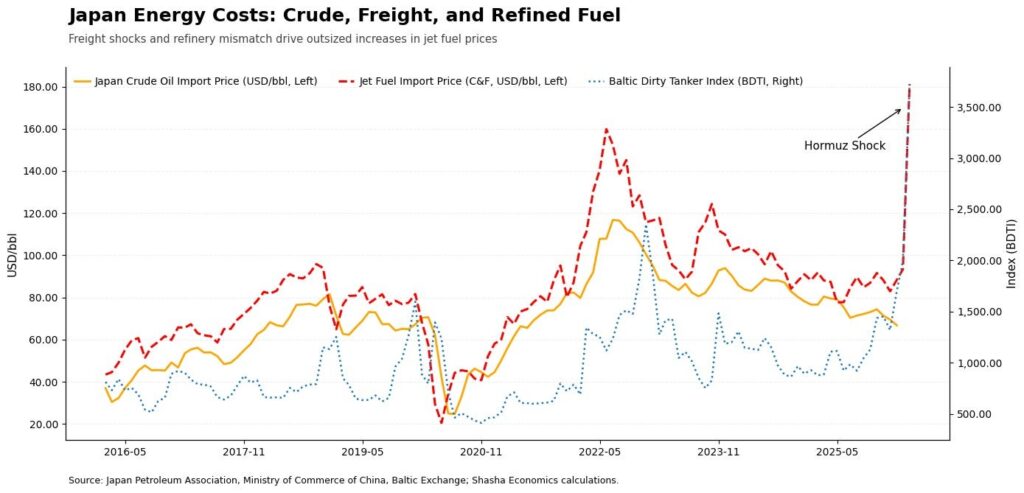
While Japan temporarily avoided energy starvation by pivoting to Trans-Pacific supply chains (primarily U.S. WTI crude), this strategy hides high economic and technical costs. Figure 3 reveals a systemic repricing of the entire cost structure.
Longer Supply Chains: The traditional route from the Persian Gulf to Chiba, Japan, is approximately 12,000 km (20–22 days). The alternative U.S. Gulf Coast route via the Panama Canal or around the Cape of Good Hope stretches to 24,000–28,000 km, lengthening transit time to 40–50 days. This forces Japan to maintain higher levels of “inventory-in-transit” to compensate for the extended cycle, significantly increasing capital tied up in the supply chain.
Shipping Market Stress: The global shipping market has undergone rapid rebalancing. As Very Large Crude Carriers avoid the Hormuz region and shift to longer Trans-Pacific journeys, shipping capacity has tightened. The Baltic Dirty Tanker Index (BDTI) surged sharply, implying that Japan is not only paying higher crude prices but also bearing substantial freight premiums.
Refining Mismatch: More fundamentally, a mismatch in crude quality has emerged at the refining stage. Japan’s refining system is optimized for medium-sour Middle Eastern crude, whereas U.S. imports are predominantly light-sweet. This shift in feedstock alters refinery yield structures, reducing output efficiency for middle distillates such as jet fuel and diesel. As shown in Figure 3, jet fuel C&F prices have risen significantly faster than crude, reaching their highest levels in nearly a decade. This excess surge is a combined result of supply chain strain and refinery system friction.
Conclusion and Outlook
In the first quarter of 2026, Japan successfully avoided an extreme energy outage by rapidly adjusting its global sourcing, but this stability came at the price of front-loaded costs. The energy supply chain is shifting from a “short-chain, low-cost” model to a “long-chain, high-security” structure.
These higher costs are likely to pass through from import prices to producer prices and ultimately to consumers, exerting sustained upward pressure on inflation. As a result, Japan’s macroeconomic challenge has evolved from a simple energy supply issue into a complex trade-off among energy security, rising costs, and economic stability.
Looking ahead to the second quarter of 2026, as long as the geopolitical risk premium embedded in the Strait of Hormuz persists, the new “high-cost, long-cycle” equilibrium in Japan’s energy system is unlikely to reverse. This structural shift may continue to compress trade surpluses and, over a longer horizon, constrain both growth dynamics and policy flexibility.