
Japan’s macroeconomic landscape is increasingly shaped by the interaction between external commodity shocks, fiscal intervention, and domestic inflation dynamics. These forces have created a highly complex policy environment for the Bank of Japan (BOJ).
Divergence Across Inflation Measures
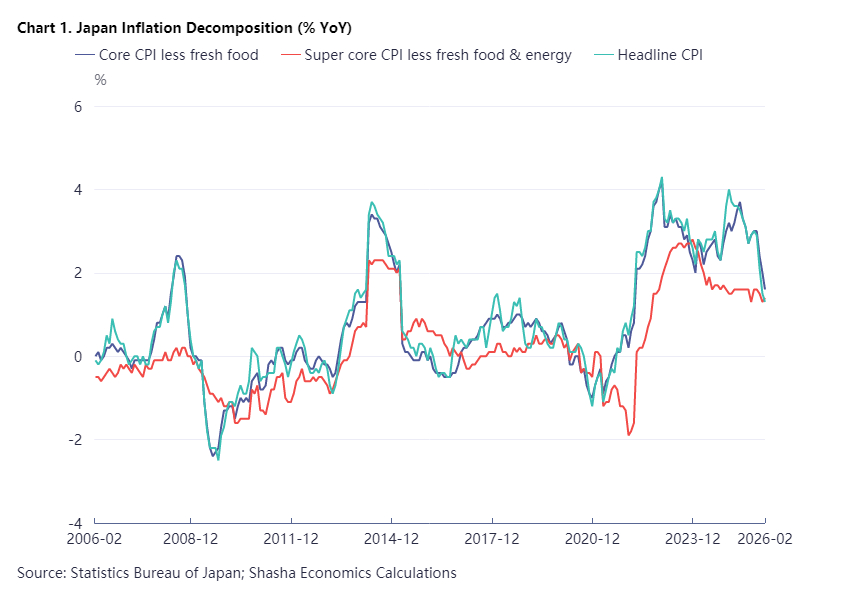
As the inflation decomposition (Chart 1) illustrates, a clear divergence has emerged across price indicators. On one side, geopolitical tensions and yen depreciation have significantly pushed up input costs across the economy. On the other, large-scale government energy subsidies have effectively imposed a “synthetic ceiling” on CPI, partially masking the inflationary pressure actually faced by households.
A Two-Channel Transmission Mechanism
This distortion can be understood through a two-channel transmission mechanism. First, oil price shocks feed directly into headline inflation by raising energy and production costs. However, this supply-side pass-through is partially offset by government subsidies, which suppress observed CPI. At the same time, higher energy prices erode real household income, weakening consumption and aggregate demand. This demand-side adjustment is ultimately reflected in super-core inflation (excluding food and energy), which may soften over time following an initial rise. As a result, while headline inflation may rise in the short term, underlying inflation momentum could gradually weaken over time.
The Dual Nature of Oil Shocks
Oil shocks exhibit a clear dual nature. While rising energy prices push up inflation in the short term, they simultaneously compress real incomes and dampen demand, generating disinflationary pressure in the medium term. This implies that the same shock can have opposing effects across time horizons: the force that raises prices today may ultimately act to suppress inflation in the future.
Japan’s current inflation dynamics are therefore characterized by two key features: a divergence between observed and underlying inflation, and a temporal mismatch between short-term inflationary pressures and medium-term disinflationary forces.